Drugs (compounds which can be addictive) affect the nervous system. Stiumulants are drugs that increase the speed of communication within nervous system (at synapses or in centres). They usually increase alertness and physical activity. They include caffeine, amphetamines, cocaine and crack. Depressants (narcotics) slow down the activity of the nervous system. For medical purposes they can calm nerves, relax muscles and help with insomnia. They include alcohol, marijuana and opium. Hallucinogens interfere with the nervous sstem in such a way that it results in distortions of the user's perception of reality. Profound images, sounds and sensations will be experienced, but they do not actually exist. Marijuana, in high doses can have this effect. LSD and magic mushrooms are other examples of hallucinogens. Drugs affect all parts of the body and can have a variety of effects depending on the user's genetic makeup, current physical and physiological state and the quality/quantity of the drug and its method of use. What all drugs share as a common problem is that with time and continued use, the body accommodates to them, so the user feels the need to increase dosages to acheive the same effect.
Stress is a common problem in modern society. Stress affects the sympathetic nervous system, which results in the increased production of adrenalin by the adrenal glands. Continuous stress can bring on many illnesses as the body's normal functions cannot occur.
Mental States
When an individual continuously feels that he or she is unable to meet the expectations of his environment, it can lead to neurosis. The unmet expectations can cause constant stress, which can lead to exhaustion, insomnia and loss of concentration. A balanced lifestyle can help to prevent/solve this problem.
Depression is psychological state when the individual's level of interest drops. There can be real, external reasons for this, but it can also occur without obvious external factors.
Paranoia is one of the most common psychological diseases, where the patient feels a constant fear. Schizophrenia is when the patient believes at times that he is someone else.
Physical States
Headaches can be cause by many factors and can be indicators of many diseases - tension, poor eyesight, encephalitis, low blood sugar, blood pressure change, low brain oxygen and many others. Migraines are intense headaches, which often affect a whole lobe of the brain and can have other symptoms, such as vision problems and nausea.
Hemorrhagic strokes (gutaütés) occur when a blood vessel in the brain is damaged (due to atherosclerosis and high blood pressure) and then oxygenated blood no longer reaches an area of the brain. Ischemic strokes (agytrombózis) occurs when a blood clot or a narrowing blocks a blood vessel in the brain, also leading to a lack of oxygen to that part of the brain. These are the most common type of strokes.
Epilepsia is the result of chaotic messages being sent through motor areas, resulting in sudden loss of conciousness and seizures
Concussions are the result of physical trauma to the brain. They can result in unconciousness, headaches, nausea and vomitting. If a person suffers from many concussions, it can lead to permanent damage.
Encephalitis (agyhártyagyulladás) is caused by viruses or bacteria that infect the membranes surrounding the brain and spinal cord. Typical symptoms include headaches, stiff neck and back, high fever, vomitting and light sensitivity.

Genetics - Some definitions before we get into the nitty gritty
Gene: a segment of DNA that codes for one characteristic
Locus: the physical position on a strand of DNA where a gene is found
Allele: an alternative form of a gene (one member of a pair) that is located at a specific location on a specific chromosome
Wildtype allele: the most commonly occurring allele in a population
Phenotype: the appearance, structural and functional characteristics of an organism
Genotype: the genes of an organism that produce the phenotypic characteristic
Dominant allele: an allele that produces the same phenotypic characteristic, whether its paired allele is the same or different.
Recessive allele: an allele that only produces its characteristic phenotype when its paired allele is identical.
Haploid: an organism (or cell) with only one copy of its genetic material (DNA)
Diploid: an organism (or cell) with two copies of its genetic material (DNA)
Homozygote: a diploid cell in which the alleles for a given gene are identical.
Heterozygote: a diploid cell in which the alleles for a given gene are different.
Classical Mendelian Genetics
 |
| Johann Gregor Mendel (1822-1884) |
Mendel chose to work with the garden pea because it grew quickly, it required little space to grow, its seeds were easy to handle, it could self-pollinate or be cross-pollinated, and there were many sub-species.
Mendel focused his studies on 7 different traits:
 |
 |
Some of his first observations showed that when he cross-pollinated purebreeding parental plants showing different characteristics (for example, purple flowers or white flowers), all of the offspring were identical (in this example all purple). The parental generation is refered to as P (parental generation) and the offspring is F1 (or first filial generation).
 |
| http://bioserv.fiu.edu/~walterm/GenBio2004/new_chap13_inheritance/pics.htm |
Parent Pea Plants
|
F1 Pea Plants
|
tall stem x short stem
|
all tall stems
|
yellow seeds x green seeds
|
all yellow seeds
|
green pea pods x yellow pea pods
|
all green pea pods
|
round seeds x wrinkled seeds
|
all round seeds
|
axial flowers x terminal flowers
|
all axial flowers
|
This led Mendel to conclude that certain traits were dominant over other traits and he created the Rule of Dominance to explain this.
Rule of Dominance: In a cross of parents that are pure for contrasting traits, only one form of the trait will appear in the next generation. Offspring that are hybrid for a trait will have only the dominant trait in the phenotype.
Mendel then took the F1 generation and let them self-pollinate.
 |
| http://bioserv.fiu.edu/~walterm/GenBio2004/new_chap13_inheritance/pics.htm |
 |
| http://www.biology.iupui.edu/biocourses/N100/2k4ch10genetics.html |
Mendel realized that these results could be explained if three things were true. He hypothesized that:
- 1. Every trait (like flower color, or seed shape, or seed color) is controlled by two "heritable factors". [We know now that these are genes - we each have two copies of every gene].
- 2. If the two alleles differ, one is dominant (will be observed in the organism's appearance or physiology) and one is recessive (cannot be observed unless the individual has two copies of the recessive allele). Dominant traits mask the appearance of recessive traits.
- 3. Alleles are randomly donated from parents to offspring - the factors (alleles) separate when the gametes are formed by meiosis, allowing all possible combinations of factors to occur in the gametes.
 |
| http://facultylounge.whfreeman.com/?q=node/1438 |
Punnett Squares
To help in solving genetic problems, Punnett squares are often used. The genotype of each parent is written on the top and left side, respectively. The two alleles are separated. Then the table is filled in with the allele from the respective side and top positions. Those are the offspring produced by the cross.
 |
| http://kids.britannica.com/comptons/art-90108/Mendels-principle-of-segregation-states-that-during-gamete-formation-the |
 |
| http://en.wikipedia.org/wiki/Punnett_square |

Geneticists use letters to represent alleles.
- A capital letter = Dominant trait, a lowercase letter = a recessive trait.
- The same letter is used to indicate both alleles.
- Flower color: P= purple, p= white
- Seed color: Y= yellow, y = green
- Seed shape: W = wrinkled, w = round
E-Z steps for doing genetics problems:
- 1. Indicate the genotype of the parents using letters
- 2. Determine what the possible gametes are
- 3. Determine the genotype and phenotype of the children after reproduction. To consider every type of offspring possible, use a Punnett Square in which all possible types of sperm are lined up vertically and all types of eggs are lined up horizontally:
- 4. Fill in the squares by "multiplying" the alleles from mom and dad.
Try to figure out the following genetics problems. Use a Punnett square. We will discuss them in class to check answers.
Genetics Problem 1: (a) A man with a widow's peak (WW) marries a woman with a continuous hairline (ww). A widow's peak is dominant over a continuous hairline. What kind of hairline will their children have?
(b) Suppose one of their children (Ww) marries someone who is also heterozygous (Ww). What type of hairline will their children have?
Genetics problem 3: A woman is homozygous dominant for short fingers (SS). She marries a man who is heterozygous for short fingers (Ss). Will any of their children have long fingers (ss)? yes / no Could any of their grandchildren potentially have long fingers? y / n Why or why not?
Genetics problem 4: Jane and John are expecting a baby and know that they are both carriers (ie heterozygous) of cystic fibrosis (Cc). What is the probability that their child will have cystic fibrosis (cc)? What is the probability that their child will be a carrier of cystic fibrosis?
Dihybrid crosses, Mendel's 2nd Law and test crosses
As Mendel did his work, he would sometimes observe 2 traits in a plant that differed from the plant it was crossed with. This is what is meant by "dihybrid" crossing. Simply, when the cross is carried out, two traits are observed.
For example, Mendel carried out a cross of a pea plant producing round, yellow peas, with a plant that produced wrinkled green peas. All of the F1 were round and yellow. When the F1 were crossed he made the following observation:
 |
| http://www.biozoomer.com/2011/03/dihybrid-cross.html |
Mendel's 2nd Law: The Law of Independent Assortment
Mendel noticed that the different traits had no impact on each other, so he concluded that genes for different traits assort independently of one another in the formation of gametes.
It is interesting to note that if you consider 1 trait at a time we get the "usual" 3:1 ratio that we saw in the single hybrid cross. Just compare the colour trait in the offspring - 12 green and 4 yellow or a 3:1 ratio. The same is seen with seed texture, showing that the traits are inherited independently of each other.
TEST CROSSES
Often when we observe the phenotype of an organism, we don't know from the phenotype whether the individual is homozygous or heterozygous for that trait. Carrying out a test cross can solve this dilemma. A test cross is simply when the individual with the unknown phenotype is crossed with a homozygous recessive individual and the ratio of offspring are observed. If all of the offspring show the dominant phenotype, then the unknown individual must have a homozygous genotype, if half the offspring are recessive, then the unknown individual must be heterozygous.
 |
| http://tipstoscore.blogspot.hu/2011/10/test-cross-mendelian-genetics.html |
Other Types of Inheritance
Intermediate Inheritance/Incomplete Dominance
One parent, carrying 2 identical alleles, shows one phenotype. The other parent, carrying two different indentical alleles, shows a different phenotype. The offspring, carrying one copy of each of the alleles, shows a third phenotype - usually intermediate between the two parental phenotypes, but clearly distinguishable from either.
And it is often seen in flowers as well:
Human blood type also shows codominant inheritance:
Blood type inheritance video
In the case of a dominant lethal gene, a 2:1 ratio is seen of the heterozygotes to the homozygous recessive.
Polygenic Inheritance
If in the parental generation a rose-comb (RRpp) is crossed with a pea-comb (rrPP), then the F1 are all walnut-comb (RrPp). If the F1 are crossed then we see the following:
Phenylketonuria (PKU) is another human example caused by a lack of phenylalanine hydroxylase (an enzyme that converts phenylalanine to valine), which results in mental retardation and reduced pigmentation.
One parent, carrying 2 identical alleles, shows one phenotype. The other parent, carrying two different indentical alleles, shows a different phenotype. The offspring, carrying one copy of each of the alleles, shows a third phenotype - usually intermediate between the two parental phenotypes, but clearly distinguishable from either.
 |
| http://bio4esobil2011.wordpress.com/2012/03/04/incomplete-dominance/ |
 |
| http://www.quora.com/If-genes-are-digital-in-replication-meaning-that-when-coupled-white-eyes-and-green-eyes-will-have-either-white-or-green-eyes-how-do-the-children-of-mixed-race-parents-have-skin-colourthat-is-intermediate |
 |
Codominance
In this case, both alleles are equally dominant and both traits will show up equally in the offspring.
The above picture is just an illustration, but this can be seen in real examples, such as the situation with horses and cows, where a white individual (WW) is crossed with a chestnut individual (RR) and the offspring show both. They are called roan (RW). |
| http://www.biologycorner.com/bio2/genetics/notes_incomplete_dominance.html |
 |
| http://www.buzzle.com/articles/codominance-explained-with-examples.html |
And it is often seen in flowers as well:
 |
 |
 |
| http://igbiologyy.blogspot.hu/2014/03/codominance.html |
Lethal Genes
The basic idea here is that if the alleles are homozygous for a lethal gene, then they cause death. The lethal gene may be dominant, in which case the dominant homozygote dies, or it may be recessive, in which case the recessive homozygote dies.
The following is a very typical example of a dominant lethal gene:
 |
| http://www.cas.miamioh.edu/~wilsonkg/old/gene2005/syllabus.htm |
With a recessive lethal gene, if it is simple dominant recessive inheritance, all the phenotypes will be the same, but if there is intermediate or codominance involved, then once again, a 2:1 ratio will be seen for the heterozygote to homozygote ratio, just in this case the homozygote will be homozygous dominant.
 |
| http://lifestunes.blogspot.hu/2010/12/lethal-white-syndrome.html |
Polygenic Inheritance
Polygenic inheritance refers to a situation where one phenotype is controlled by 2 or more genes.
Difactorial inheritance is the term used when 2 genes control one phenotype, for example the shape of chicken combs.
 |
| http://www.bio.miami.edu/dana/250/250SS13_6.html |
 |
| http://www.extension.org/pages/65363/poultry-genetics-for-small-and-backyard-flocks:-an-introduction#.VDGWBPl_to0 |
Or 9 walnut: 3 rose: 3 pea: 1 single. The ratio of a dihybrid cross, just with one phenotype being dealt with, not 2!
Quantitative Inheritance
This kind of inheritance is observed when many genes are involved in producing a phenotype and the frequency of the phenotypes usually exhibit a normal continuous distribution (aka bell curve). Examples of this include skin colour, hair colour, eye colour, height and weight in humans.
Pleiotropy
 |
| http://bioserv.fiu.edu/~walterm/FallSpring/inheritance/Fall03_lecturea.htm |
Pleiotropy
In this situation, 1 gene is responsible for more than 1 characteristic or trait.
 |
A good example of this in humans is sickle-cell anemia, where one gene causes the cell to have a sickle-shape, which results in many different symptoms, including anemia, skull deformation and enlarged liver and resistance to malaria.
Phenylketonuria (PKU) is another human example caused by a lack of phenylalanine hydroxylase (an enzyme that converts phenylalanine to valine), which results in mental retardation and reduced pigmentation.
Linked Inheritance
THOMAS HUNT MORGAN and his work
T.H. Morgan studied fruit flies (muslica). One day, in 1910, he came across male fruit flies that had white eyes. They were mutants among the red-eyed wildtypes.
He then bred the white-eyed males with red-eyed females and all of the offspring had red eyes.
The F2 progeny though, contained males with white eyes.
From this, Morgan concluded that in some way eye colour was associated with the gender of the animal and that this association was because the gene that determined eye colour was on the same chromosome that determined the gender (or sex) of the animal.
What are sex chromosomes?
In animals, sex chromosomes define the animal's sex and are an unmatched chromosome pair.
In most animals:
XX is female
XY is male
But there are some animals among the butterflies, birds, snakes and fish in which:
WZ is female
WW is male
So, in animals with XX, XY sex chromosomes, the female carries a matched pair of chromosomes (therefore two alleles for each gene coded on the X chromosomes) and the male carries an unmatched pair (thus only one allele for each gene coded on the X chromosome - so recessive characteristics for these genes show up more often in males, since there is no pair that might be dominant)
Most sex-linked traits are coded for on the X chromosome, since it is the larger of the two chromosomes, but there are a few characteristics that are coded on the Y. For example, in mammals, the gene that triggers testis (here) development is found on the Y chromosome (logically enough!!).
Recessive forms of sex-linked traits that are coded on the X chromosome show up more commonly in males, since they only need one allele to express the phenotype, while females require two recessive alleles to express the phenotype.
Some typical human sex-linked (or X-linked) characteristics include a form of haemophilia and red-green colour-blindness. About 8% of males are red-green colour-blind, but only 0.7% of females are.
Going back to fruit flies.....
Morgan observed that some flies had miniature wings and that this also showed sex-linked inheritance, suggesting that the gene for wing size was on the X chromosome. But he also noticed that having miniature wings and white eyes most often showed up together, but NOT always. Sometimes the flies had white eyes and mini wings, sometimes they had white eyes and long wings.....
This led him to the idea of Genetic Linkage.
This is the idea that if 2 genes are found on the same chromosome, then the alleles on that chromosome usually sort together in the production of gametes. Occasionally though, the two alleles sort separately. Morgan was able to explain this with crossing-over which occurs during meiosis.
So linkage can be observed with the sex of the organism, but it can also be observed between traits found on the same autosomal (not sex) chromosomes.
Morgan observed that certain traits in fruit flies tended to be found together (irrelevant of the sex of the fly). For example, grey flies tended to have long wings, while black flies tended to have vestigial (csökevényes) wings. So he assumed that the genes for these two characteristics are on the same chromosome. If these characteristics are inherited together, he expected the following:
In reality, a 3:1 ratio is not acheived, because total linkage is very rare since crossing over occurs. So Morgan actually saw four different phenotypes as follows:
Note that the majority of the offspring were like one or the other parent and only a small percentage showed a recombination of the traits.
This recombination was the result of crossing over occuring on the chromosome at a point between the two genes.
Morgan suggested that the likelyhood of crossing over occuring between two genes increases as the distance between two genes increases.
And observing the number of offspring that are like the parents and the number that are not (the recomibinants), a frequency of recombination can be calculated and this can be used to predict distances between genes on a chromosome.
Since Morgan came up with this idea, some time later the English geneticist, J.B.S. Haldane, suggested name the measurement of distance on the chromosome after Morgan. So today a 1% frequency of recombination is also called 1 map unit or 1 centiMorgan.
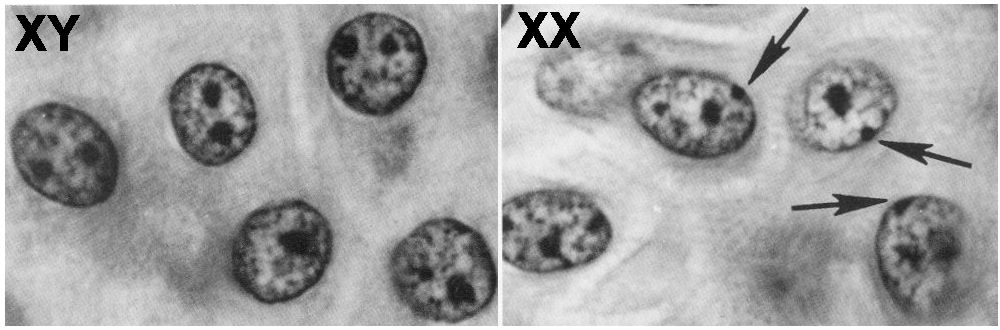
They concluded that the dark spot was a tightly coiled X chromosome and named it a Barr body. So in all female cells, one X chromosome has normal appearance and is in its active state, while the other is tightly coiled up and in a resting state. This is called X inactivation. The determination of which X chromosome coils and which remains active occurs early in development and seems to be random from cell to cell.
T.H. Morgan studied fruit flies (muslica). One day, in 1910, he came across male fruit flies that had white eyes. They were mutants among the red-eyed wildtypes.
He then bred the white-eyed males with red-eyed females and all of the offspring had red eyes.
The F2 progeny though, contained males with white eyes.
 |
What are sex chromosomes?
In animals, sex chromosomes define the animal's sex and are an unmatched chromosome pair.
In most animals:
XX is female
XY is male
But there are some animals among the butterflies, birds, snakes and fish in which:
WZ is female
WW is male
So, in animals with XX, XY sex chromosomes, the female carries a matched pair of chromosomes (therefore two alleles for each gene coded on the X chromosomes) and the male carries an unmatched pair (thus only one allele for each gene coded on the X chromosome - so recessive characteristics for these genes show up more often in males, since there is no pair that might be dominant)
Most sex-linked traits are coded for on the X chromosome, since it is the larger of the two chromosomes, but there are a few characteristics that are coded on the Y. For example, in mammals, the gene that triggers testis (here) development is found on the Y chromosome (logically enough!!).
Recessive forms of sex-linked traits that are coded on the X chromosome show up more commonly in males, since they only need one allele to express the phenotype, while females require two recessive alleles to express the phenotype.
Some typical human sex-linked (or X-linked) characteristics include a form of haemophilia and red-green colour-blindness. About 8% of males are red-green colour-blind, but only 0.7% of females are.
 |
Going back to fruit flies.....
Morgan observed that some flies had miniature wings and that this also showed sex-linked inheritance, suggesting that the gene for wing size was on the X chromosome. But he also noticed that having miniature wings and white eyes most often showed up together, but NOT always. Sometimes the flies had white eyes and mini wings, sometimes they had white eyes and long wings.....
This led him to the idea of Genetic Linkage.
This is the idea that if 2 genes are found on the same chromosome, then the alleles on that chromosome usually sort together in the production of gametes. Occasionally though, the two alleles sort separately. Morgan was able to explain this with crossing-over which occurs during meiosis.
 |
So linkage can be observed with the sex of the organism, but it can also be observed between traits found on the same autosomal (not sex) chromosomes.
Morgan observed that certain traits in fruit flies tended to be found together (irrelevant of the sex of the fly). For example, grey flies tended to have long wings, while black flies tended to have vestigial (csökevényes) wings. So he assumed that the genes for these two characteristics are on the same chromosome. If these characteristics are inherited together, he expected the following:
 |
 |
In reality, a 3:1 ratio is not acheived, because total linkage is very rare since crossing over occurs. So Morgan actually saw four different phenotypes as follows:
 |
Note that the majority of the offspring were like one or the other parent and only a small percentage showed a recombination of the traits.
 |
Morgan suggested that the likelyhood of crossing over occuring between two genes increases as the distance between two genes increases.
 |
And observing the number of offspring that are like the parents and the number that are not (the recomibinants), a frequency of recombination can be calculated and this can be used to predict distances between genes on a chromosome.
 |
 |
A few more interesting things.....
If you remember back to last year, you may recall learning about Lynn Margulis' Endosymbiotic Theory, about how eukaryotes came to be. When we discussed it, we said that one of the proofs for her theory was that the mitochondria had its own DNA. It is called mitochondrial DNA. It is a small circular DNA, similar to that of prokaryotes. In most organisms the mitochondrial DNA is inherited solely from the mother. So mitochondrial DNA can be used to research the maternal line of ancestry of an individual. (Likewise, since the Y-chromosome is only inherited in males, it can be used to research the paternal line).
A famous case that was solved using mitochondrial DNA was that of the woman who claimed she was Anastasia Romanov (daughter of Csar Nicholas, who was killed by the Bolsheviks). In the 1920's a woman appeared in Berlin claiming to be the princess. The royal families of Europe refused to believe her claim, but she spent her whole life claiming that is who she was. After her death, researchers used mitochondrial DNA from her hair and compared it with that of Prince Philip (consort to Queen Elizabeth II), who would be Anastasia's closest living relative in her maternal line. It was not a match.
Barr Bodies
In the 1940's some researchers noticed dark staining spots at the edge of the nucleus in female somatic cells, but not in males.
 |
 |
This is very obvious in calico or tortoiseshell cats.
 |
| A female calico cat |
Since one aspect of colouration is an X-linked gene, the situation where the cat is not a solid colour only shows up in heterozygous females, depending on which X became inactive (a Barr body)
 |
Family Pedigrees
Pedigrees, or the creation of family trees, are often used in the genetic research of humans, especially in the research of genetically determined diseases. They play a particularly important role, as humans have very long generations (approximately 17-22 years) and very few offspring.
Pedigrees can indicate if the condition is autosomal or sex-linked and whether it is dominant or recessive.
Standard symbols are used in the creation of pedigrees so that they can be easily understood.
 |
 |
 |
| This pedigree considers attached earlobes (or the recessive phenotype) to be the condition being studied, so the homozygous recessive individuals are the coloured symbols. |
 |
| A pedigree for an unknown X-linked dominant condition |
 |
 |
| A pedigree for Y-linked inheritance |
Subscribe to:
Posts (Atom)